

What does a chiropractor do? A plain-English guide to adjustments, conditions treated, and what to expect at a Lenexa visit. Call (913) 227-0909.
Ask ten people what a chiropractor actually does and you will get ten different answers. Some picture dramatic back cracking. Others assume it is only for back pain. A few are not sure whether it counts as real healthcare at all. Those gaps in understanding are the single most common reason people in Lenexa put off care that could have helped them months earlier.
The honest answer is more practical and less mysterious than most expect. This guide explains what chiropractors are trained to do, which conditions we treat most often, what happens during a visit, and just as importantly, when chiropractic is not the right answer for your situation.
What a Chiropractor Is Trained to Do
A Doctor of Chiropractic is a licensed healthcare provider who diagnoses and treats disorders of the musculoskeletal system, with particular focus on the spine and how it affects the nervous system. Training covers anatomy, physiology, neurology, orthopedics, diagnostic imaging, and hands-on clinical practice.
In day-to-day practice, the work breaks into four parts: evaluating how your body moves and where it does not, identifying the mechanical source of your symptoms, applying hands-on treatment to restore normal function, and giving you the exercises and habits that keep the problem from returning.
The National Center for Complementary and Integrative Health describes chiropractic as a licensed healthcare profession whose practitioners use hands-on spinal manipulation along with other treatments, and notes that spinal manipulation is among the most studied of these approaches. It is a regulated clinical profession, not an alternative fringe practice.
The Core Idea Behind the Work
Your spine does two jobs at once. It carries load and allows movement, and it houses the nervous system that controls everything else. When a spinal joint stops moving properly, the effects are not limited to that one spot. Surrounding muscles tighten protectively, nearby nerves can become irritated, inflammation builds, and the rest of the body starts compensating in ways that create new problems.
Chiropractic care interrupts that chain. Rather than treating the pain where you feel it, the goal is to find and correct the mechanical dysfunction producing it.
What Chiropractors Actually Treat
The pattern we see most often in Lenexa is not dramatic injury. It is the accumulation of ordinary strain: desk work, poor sleep positions, weekend yard work, and old injuries that never fully resolved. The conditions that bring people in most frequently include:
- Lower back pain. The most common reason patients seek chiropractic care anywhere, and the condition with the strongest research support. See our approach to chronic back pain.
- Neck pain and stiffness. Increasingly driven by screen posture. Our neck pain care addresses both the joints and the muscles involved.
- Tension headaches. Frequently originating from cervical restriction rather than anything in the head itself.
- Sciatica and radiating pain. When nerve irritation stems from the lumbar spine, addressed through targeted sciatica care.
- Joint pain in the shoulders, hips, and knees. Extremity joints respond to the same principles as the spine.
- Post-accident injuries. Including whiplash and the alignment changes collisions leave behind.
- Reduced mobility and stiffness. Often the earliest sign of a problem, and the easiest stage to correct.
What Happens During a Chiropractic Visit
Knowing the sequence removes most of the hesitation people feel before a first appointment.
Evaluation Before Anything Else
No treatment happens without an assessment. Dr. Meylor reviews your health history, then evaluates posture, range of motion, joint restriction, muscle tone, and neurological signs such as reflexes and sensation. This determines whether chiropractic care is appropriate for you at all, and if so, which technique fits.
The Adjustment
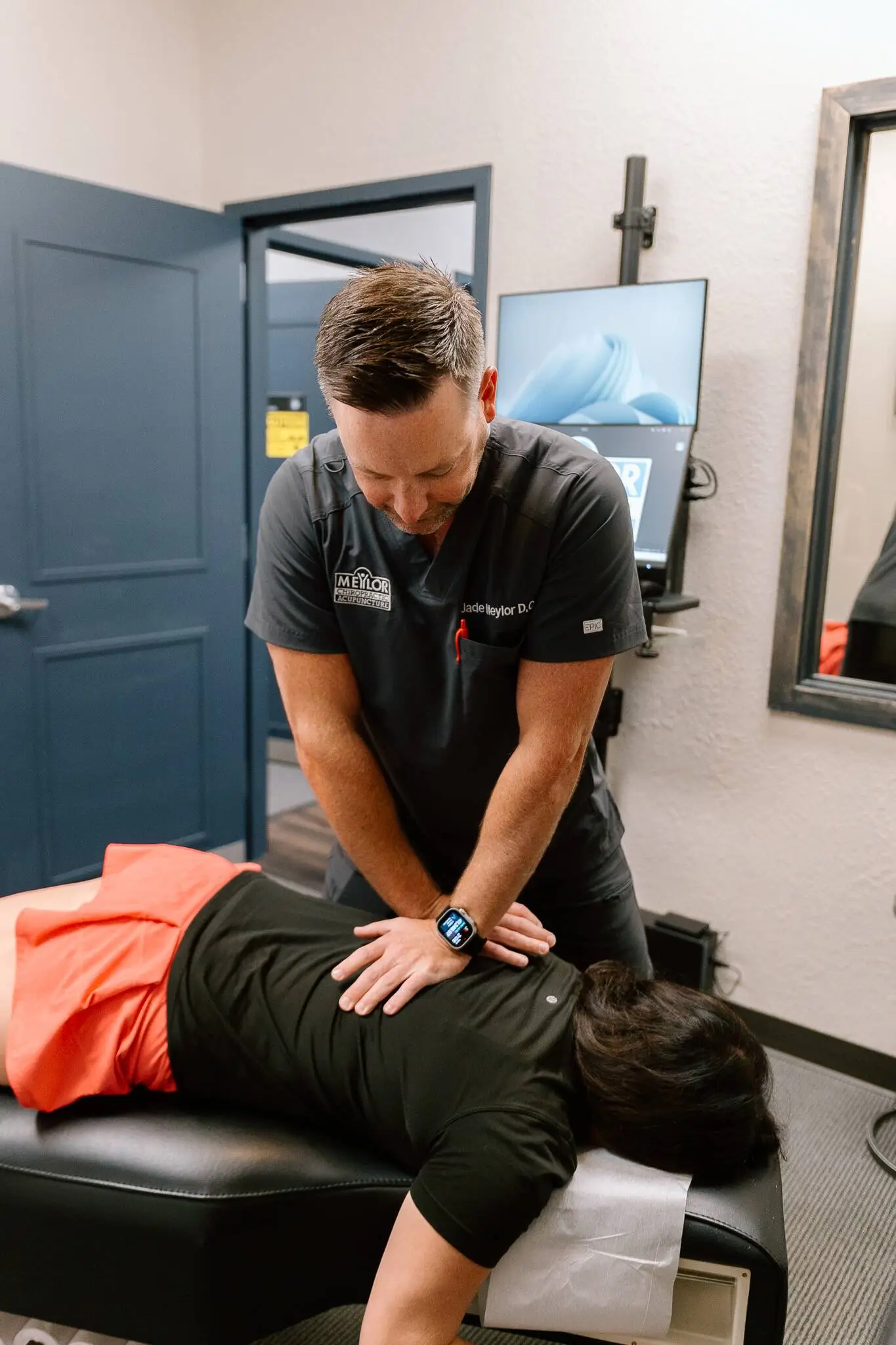
A chiropractic adjustment is a precise, controlled force applied to one specific joint to restore its normal motion. It takes a fraction of a second. Most patients describe brief pressure followed by a sense of release. The popping sound that sometimes accompanies it is gas releasing from the joint fluid, not bones cracking, and an effective adjustment does not always produce one.
Technique Is Chosen for the Patient
Chiropractic is not one technique applied identically to everyone. The method is selected based on your age, condition, and comfort level:
- Diversified technique. The traditional manual adjustment using a quick, specific thrust.
- Activator method. A handheld instrument delivering a gentle low-force impulse with no twisting, well suited to seniors and patients with arthritis.
- Drop table. A section of the table drops slightly so very little force is required.
- Flexion-distraction. Gentle rhythmic decompression used for disc-related injuries.
- Soft tissue work. Muscle release that accompanies adjustments to reduce surrounding tension.
Beyond the Adjustment
Adjustments alone rarely produce lasting change. What holds the correction is what happens between visits: corrective exercises, ergonomic changes, and movement habits. Our full chiropractic care services include this guidance as standard rather than as an upsell.
Where Chiropractic Fits in Holistic Health Approaches
Chiropractic works best as one part of a broader picture rather than a standalone fix. Structure, nervous system regulation, movement, sleep, and stress all influence how you feel, and treating one while ignoring the rest limits results.
That is why many patients in Lenexa combine chiropractic with acupuncture care, which addresses inflammation and nervous system regulation from a different angle. Adjustments correct the mechanics. Acupuncture calms the pain signaling and stress response layered on top of them. Together they cover ground neither reaches alone.
When Chiropractic Is Not the Right Answer
Being straight about limitations matters more than being persuasive. Chiropractic care is effective for mechanical musculoskeletal problems. It is not a treatment for infection, cancer, fractures, or systemic disease, and it does not replace necessary medical care.
Seek emergency medical care instead of booking an adjustment if you have: sudden weakness or numbness on one side of the body, loss of bowel or bladder control alongside back or leg symptoms, severe unrelenting pain following significant trauma, signs of infection such as fever with back pain, or numbness accompanied by vision changes or slurred speech.
Certain conditions also call for modified technique or make manipulation inappropriate, including severe osteoporosis, spinal tumors, some bone abnormalities, and elevated stroke risk. The Mayo Clinic notes that chiropractic adjustment is generally safe when performed by a trained, licensed practitioner, and that evaluation should always precede treatment. This is exactly why the assessment is never skipped, and why we refer patients elsewhere when their situation calls for it.
Have Questions? Ask Before You Commit
If you are still unsure whether chiropractic care fits your situation, a conversation costs nothing. We offer free consultations at our Lenexa office so you can get a straight assessment before making any decision.
Schedule Free Consultation Call (913) 227-0909
Frequently Asked Questions
What does a chiropractor do on the first visit?
The first visit is mostly evaluation. Dr. Meylor reviews your health history, assesses posture, range of motion, joint function, and neurological signs, then explains what is driving your symptoms. Treatment follows only if chiropractic care is appropriate for your condition.
Is a chiropractor a real doctor?
A Doctor of Chiropractic is a licensed healthcare provider who completes doctoral-level training in anatomy, neurology, orthopedics, diagnosis, and imaging. Chiropractors are licensed and regulated in every state, including Kansas.
Do chiropractors only treat back pain?
No. Back pain is the most common reason people come in, but chiropractors also treat neck pain, tension headaches, sciatica, extremity joint problems, post-accident injuries, and mobility restriction.
Does a chiropractic adjustment hurt?
For most patients, no. The common description is brief pressure followed by relief. Mild soreness for a day afterward is normal, similar to after exercise. Gentle low-force techniques are available if you are concerned about discomfort.
Do I need a referral to see a chiropractor in Kansas?
No referral is required. You can call our Lenexa office directly at (913) 227-0909 to schedule a free consultation.
How do I know if I need a chiropractor or a medical doctor?
If your pain is mechanical, meaning it changes with movement or position and followed strain, posture, or injury, chiropractic care is a reasonable starting point. If you have fever, unexplained weight loss, progressive weakness, or the emergency signs listed above, see a physician first. We will refer you if your evaluation points that direction.
Visit Our Lenexa Chiropractic Office
Our office is located at 12980 W 87th St Pkwy in Lenexa, easy to reach from Overland Park, Shawnee, Olathe, and the surrounding Johnson County communities. Whether this is your first time considering chiropractic care or you are returning after a break, we will make sure you understand what we are doing and why.
Meylor Chiropractic and Acupuncture
Provider: Dr. Meylor
Address: 12980 W 87th St Pkwy, Lenexa, KS 66215
Phone: (913) 227-0909
Hours: Monday through Thursday, 9:30 AM to 12:30 PM and 3:00 PM to 6:00 PM. Closed Friday through Sunday.
Serving: Lenexa, Overland Park, Shawnee, Olathe, Leawood, Prairie Village, Merriam, Mission, and surrounding Johnson County, Kansas communities.
*This article is educational and is not a substitute for individualized medical advice. Consult a qualified healthcare provider about your specific condition.*